


How Franchise Support Reduces Your Risk as a First-Time Gym Owner?

Opening a gym looks simple from the outside, buy equipment, rent a space, sign up members. The reality is that fitness is one of the more unforgiving categories in small business, and most of the risk a first-time owner faces isn't about passion for fitness, it's about business fundamentals they've never had to manage before. If you're researching how to start a gym the right way, this is exactly where franchise support changes the equation. Done right, it doesn't just hand you a brand name, it hands you a tested system for avoiding the specific mistakes that sink new gyms before they even open a gym doors.
Here we break down where that risk actually comes from, what verified data says about franchise vs. independent survival, and how structured franchise support covering equipment, marketing, operations, and finance closes the gap for first-time owners and the investors backing them.
Why First-Time Gym Owners Fail (The Risk Landscape)
Before looking at solutions, it's worth being precise about where the risk actually sits, because "gyms are risky" is too vague to act on.
Undercapitalization and cash flow mistakes.
Most new gym owners underestimate how long it takes to break even. Industry data shows new fitness facilities commonly operate at a loss for the first six months to a year before stabilizing, a runway many first-time owners simply haven't budgeted for.
Wrong equipment decisions.
Overbuying premium machines nobody uses, or underbuying capacity for the member base you're targeting, is one of the most common and expensive early errors and it's hard to reverse once capital is committed.
No proven member-acquisition system.
Many first-time owners assume a good location and clean facility will generate footfall on its own. It doesn't. Member acquisition is a system, not an outcome of effort.
Operational blind spots.
Staffing structure, class scheduling, trainer certification, compliance, and member retention tracking are all areas where inexperienced owners learn by making costly mistakes rather than following a playbook.
These four categories: capital, equipment, marketing, and operations are also, not coincidentally, the exact areas where structured franchise support is built to intervene.
“Money is the biggest worry for any first-time gym owner and for the investor backing them. The numbers from India back this up.”

Financial Risk: How Franchise Support De-Risks the Investment
According to data tracked across Indian startups and small businesses, around 20% of new ventures shut down in their very first year. By year two, this rises to 30%, and by year five, nearly half don't survive. In simple terms: for every 10 gyms or fitness businesses that open in India this year, roughly 2 will shut within 12 months and that's before counting fitness-specific problems like equipment cost overruns or member drop-off.
This is the baseline risk every new franchise business India carries. A gym franchise India model doesn't make this risk disappear completely, but it changes the odds in a very practical way.
Here's how:?
A franchise system that has already opened gyms in multiple cities knows the real numbers not guesswork. They know roughly how much a gym in a Tier-1 city like Chandigarh or Mohali actually costs to set up, how much working capital is needed to survive the first 6-8 months (when most new gyms are still running at a loss), and where first-time owners typically overspend. A solo first-time owner is usually building this budget from scratch, often based on best-case assumptions rather than real data.
This matters even more right now because India's fitness industry is in a strong growth phase, the commercial fitness market is growing at roughly 15% per year and is expected to more than double in size by 2030 stated by Health & Fitness Association report. That's good news for anyone entering the space, but fast-growing markets also attract fast, undercapitalized gyms that open on excitement rather than a properly planned budget. This is exactly the group most likely to become part of that year-one failure number.
Equipment & Setup Risk : Getting It Right the First Time
Equipment decisions are capital decisions, and they're among the hardest to undo once a gym is operating. A first-time owner working alone is essentially guessing at gym equipment mix, footfall-to-equipment ratios, and layout flow based on what looks good rather than what performs.
Franchise support typically brings three things to this problem:
Proven equipment list : calibrated to the specific gym format and member profile, so you're not guessing what to buy.
Layout planning : based on dozens of prior rollouts, not just one person's intuition.
Vetted supplier relationships with a trusted gym equipment manufacturer India protects against delivery delays, inconsistent build quality, or warranty gaps.
All of which are common pain points for owners sourcing equipment independently for the first time. For a first-time owner, this alone removes one of the largest single points of financial exposure in the entire setup phase.

Marketing Risk : Why "Build It and They Will Come" Fails
India's fitness market is in a genuinely strong growth phase commercial fitness revenue is projected to grow at roughly 15% CAGR from 2024 to 2030, with the overall market expected to more than double in size by the end of the decade, even though gym membership penetration nationally still sits below 1% of the population. That combination has strong growth, low penetration means demand exists, but it has to be actively captured, not assumed.
This is also visible in how concentrated the opportunity currently is: India had an estimated 46,500 fitness facilities in 2024, yet the top 10 cities generated 56% of total industry revenue while accounting for just 31% of facilities, a clear signal that location and local market execution matter enormously, and that marketing capability, not just market size, decides who actually captures demand.
A first-time independent owner typically starts local marketing from zero, no proven ad creative, no tested member-acquisition funnel, no brand recognition to borrow against. Franchise support changes this by providing pre-built marketing playbooks, tested lead-generation systems, and brand equity the owner didn't have to build themselves. International brands expanding aggressively into India right now Crunch Fitness signed a master franchise agreement for a minimum of 75 locations across the country in 2025 (Health Club Management) are betting specifically on this: that a recognizable system with a built-in acquisition engine outperforms a standalone gym competing purely on local reputation.
This is exactly the model behind PUG Franchise among all the 200 branches. Instead of a new owner starting from scratch, they step into a system that's already been tested across multiple locations, proven Ad creative, a lead-generation funnel that's already converting, and a brand name local customers can recognize from day one instead of a logo no one has seen before. The bet is simple: a new gym backed by a system with a built-in acquisition engine will out-market a standalone gym trying to build local reputation one customer at a time.
Operational Risk : Staffing, SOPs, and Day-to-Day Management
Retention, not acquisition, is usually what separates a gym that survives year one from one that doesn't.
“Industry data shows the most successful gyms maintain member retention above 70% year-over-year, while the broader industry average sits closer to 50%”
That gap is rarely about the equipment or the space. It's about staffing structure, trainer quality, class scheduling, and whether there's a system tracking member engagement before someone quietly stops showing up. This is where franchise-backed SOPs, staff training programs, and gym management software do the heaviest lifting replacing ad-hoc, owner-dependent operations with a tested structure the owner didn't have to design from scratch.
What the Data Says: Franchise vs. Independent Survival, in Context
Putting the India-specific numbers together: out of roughly 69,400 gyms operating across the country, only about 14% are franchise-led, the remaining 86% run independently. Independent gyms also carry a meaningfully higher failure rate, with roughly 20% closing within the first year, compared to roughly 5% for franchise locations, according to the data in our detailed comparison, Gym Franchise vs Independent Gym: Which Business Model Is Better?.
Part of that gap comes from the franchise model itself, a tested playbook reduces the number of ways a new owner can go wrong. But part of it also comes from who tends to choose each path: franchise buyers are typically better capitalized and more carefully screened going in, while independent owners are more likely to launch on passion and a tighter budget. For an investor comparing the two paths, that's the honest, data-grounded version of the risk gap, real and meaningful, but not a guarantee either way.
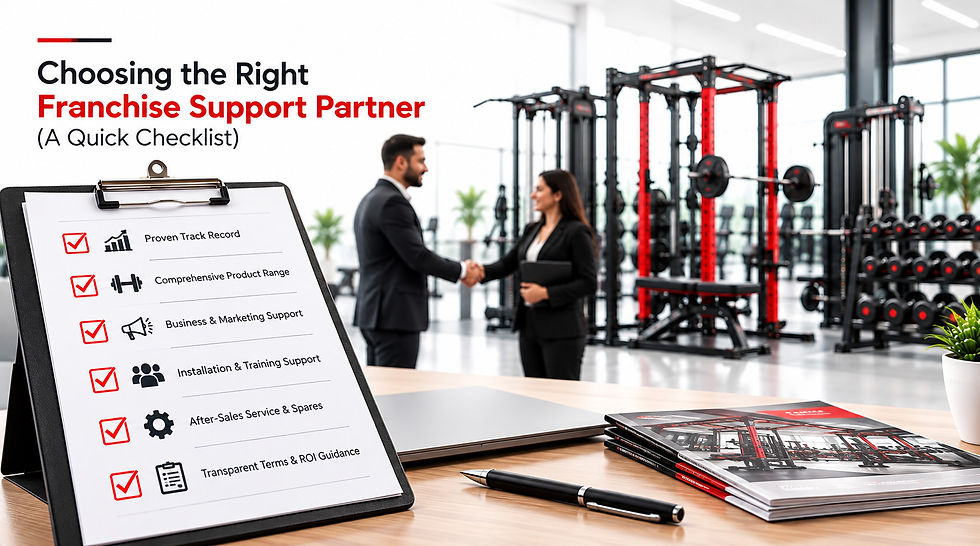
Choosing the Right Franchise Support Partner (A Quick Checklist)
Not all franchise support is equal, so it's worth evaluating a partner on specifics rather than brand promises alone:
Does the equipment package come from a vetted manufacturer with warranty and after-sales support, not just a supplier list?
Is there a documented, tested marketing system for new-location launches, or just general brand marketing?
Are SOPs, staff training, and management software included, or left to the owner to build independently?
Can the franchisor show real financial benchmarks from existing locations, not projected or best-case numbers?
Is there ongoing support post-launch, or does help end once the gym opens?
Conclusion
New gyms come with real risk, that's just the truth, backed by the data. But franchise support doesn't make that risk disappear with some magic trick. It reduces it in a very practical way: by handing first-time owners a tested system instead of guesswork, whether that's picking the right equipment, running marketing that actually brings in members, managing daily operations, or planning finances realistically.
So the real question isn't "will there be risk?" there always is, with any new business. The real question is: do you want to face that risk alone, or with a partner who has already made the costly mistakes at someone else's gym, not yours?
Want detailed knowledge about our franchise system? Get in touch with us at 90561-74269.
Comments