


Gym Franchise vs Independent Gym: Which Business Model Is Better?
Updated: Sep 30
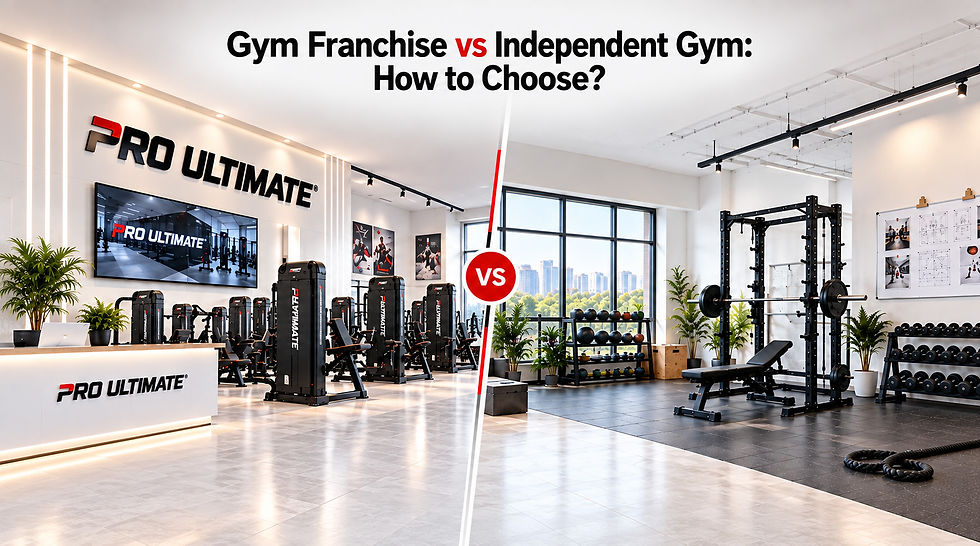
Owning a gym is an exciting business opportunity for any entrepreneur or fitness and health enthusiast, but deciding how to structure your fitness business is a significant first step. Aspiring gym owners have two primary paths: gym franchise vs. independent gym ownership.
A gym franchise offers brand recognition, corporate support, and a proven business model, while an independent gym offers creative freedom but comes with higher risk. That gap shows up clearly in India's own numbers: out of roughly 69,400 gyms in the country, only about 14% are franchise-led, organised franchise players, the remaining 86% run independently.
This guide breaks down both models so you can decide which one fits your goals and risk tolerance.
What Is a Gym Franchise?
A gym franchise is a business model that allows a gym owner to operate a gym under an established brand name by paying an upfront franchise fee and ongoing royalties. This model provides a structured approach to business ownership, offering corporate support in key areas such as branding, marketing, operations, and training. Franchisees gain access to proven systems that have helped build the brand's success, reducing the risks associated with starting a gym from scratch. This support network is the underlying benefit of a gym franchise, as it helps the gym owner by providing a template to work off of.
How a Gym Franchise Works?
When gym owners invest, they enter into a contractual agreement with the franchisor such as Anytime Fitness, Pro Ultimate, Gold’s Gym, or Cult.fit, granting them the right to use the brand’s name, business model, and proprietary systems. This agreement typically outlines:
Brand Guidelines: Franchisees must follow standardized branding, signage, and facility layouts to maintain brand consistency.
Equipment and Facility Standards: Gym owners must use approved equipment vendors and maintain a specific facility design.
Corporate Training and Support: The franchisor provides business training, marketing materials, and operational guidance.
Marketing and Lead Generation Assistance: Franchisees benefit from corporate-led advertising campaigns and digital marketing strategies.
Ongoing Fees: Franchisees pay monthly or annual royalties to the corporate office for continued support and brand access.
Benefits of a Gym Franchising
There are significant advantages to working with an existing franchise, including:
Proven Business Model: Gym franchises operate under established systems tested in multiple markets. This A/B testing process lowers the risk of business failure compared to independent gym ownership.
Brand Recognition: Customers are likelier to trust and join a well-known fitness brand than an unknown gym. This brand trust can accelerate membership growth and retention.
Marketing & Training Support: Franchisees receive corporate marketing assistance, including national advertising, social media strategies, and local marketing materials. Additionally, training programs help owners understand business operations, sales tactics, and member retention strategies.
Easier Financing: Banks and lenders are often more willing to approve loans for franchise businesses due to their proven success and structured operations.
What Is an Independent Gym?
An independent gym is a fitness business built from the ground up, with no franchisor behind it. The owner has full say over branding, pricing, equipment, and how the business is marketed but that freedom comes at a cost: getting it off the ground demands real business know-how, marketing chops, and a meaningful capital outlay.
How an Independent Gym Works?
There's no corporate playbook here everything rests on the owner, including:
Designing the brand identity, logo, and layout of the space from zero
Choosing equipment, deciding what to charge members, and shaping the service menu
Building, funding, and running every marketing effort without outside help
Driving growth purely through their own ability to bring in and keep members
Pros of an Independent Gym
Full Creative Control: The owner calls every shot brand direction, pricing, service mix giving the gym a completely custom identity shaped entirely around their vision.
No Franchise Costs: There's no upfront franchise fee and no ongoing royalty cut to pay out, unlike the franchise model.
Keeps 100% of the Profits: Since there's no royalty or brand fee eating into monthly revenue, every rupee earned stays in the business giving the owner more room to reinvest in equipment, staff, or expansion instead of routing a fixed cut back to a franchisor.
Cons of an Independent Gym
Greater Financial Exposure: Without a franchisor's backing, independent gyms carry more failure risk, owners often struggle to bring in members, absorb overhead, and manage day-to-day operations on their own.
Demands Serious Marketing and Business Skill: With no corporate ad campaigns or operational playbook to lean on, owners have to fund and run their own local marketing, social presence, and referral efforts, while also mastering the financial side to keep the business scaling.
No Safety Net: From hiring to book-keeping to facility maintenance, the owner handles it all solo, with no external framework to fall back on.
Franchise vs Independent Gym
Before diving into the details, here's a quick side-by-side of how the two models stack up on the factors that matter most to an investor: what it costs to start, how risky it is, how much control you keep, what support you get, and how long until you break even.
Factor | Gym Franchise | Independent Gym |
Cost | ₹50L–₹4Cr+ (franchise fee + build-out + royalty) | ₹25L–₹5Cr+ (fully self-funded, no fees) |
Risk / Failure Rate | ~5% fail in year one | ~20% fail in year one |
Control | Limited — must follow brand guidelines | Full — owner decides everything |
Support | Corporate training, marketing, systems | None — owner builds it all |
Break-even Timeline | 12–24 months | Varies widely, often longer |
Cost Breakdown: Franchise Fees vs Independent Startup Budget
Money is usually the deciding factor, so let's put real numbers next to both models.
In India, franchise fees alone typically run ₹15 lakh-₹50 lakh, with total investment fee, build-out, and equipment included landing between ₹50 lakh and ₹4 crore, plus an ongoing royalty of 4–8% of revenue. This is roughly where most contenders for the best gym franchise in India fall, depending on brand tier and city category. Independent setups have no franchise fee at all, but total spend still swings wide, roughly ₹25 lakh to ₹5 crore+, depending purely on scale and ambition.
In India, the range looks like this:
Anytime Fitness : ₹1-2 Cr
Snap Fitness : ₹80 lakh-1.5 Cr
Cult.fit : ₹50 lakh-1.2 Cr
Mid-market regional franchises : ₹25-80 lakh, a more accessible entry point for first-time investors
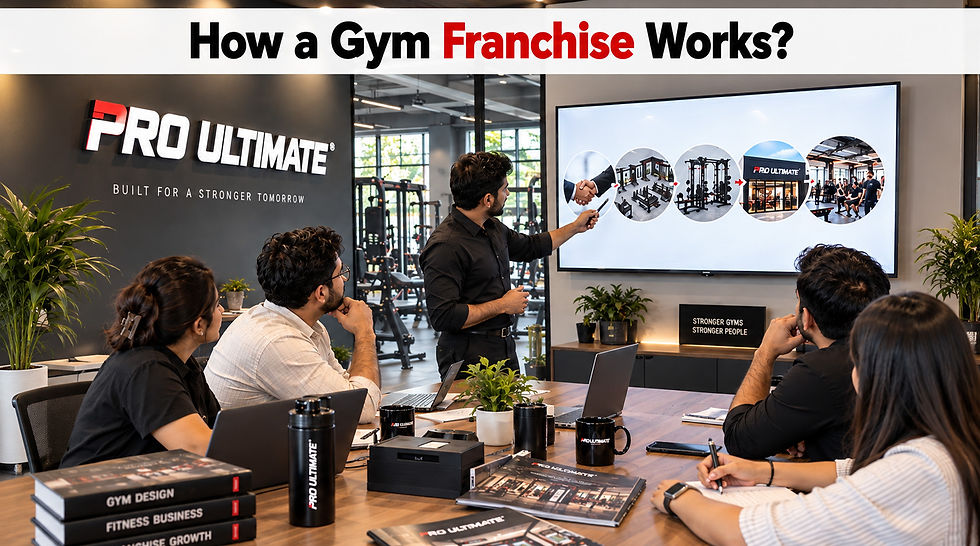
Where PUG Franchise fits in: Pro Ultimate Gyms sits at an investment of ₹99 lakh and above, for a facility of 5,000 sq. ft. and above with the brand citing an ROI window of 6-12 months, faster than the 12-24 month range typical elsewhere in the industry. The bundle covers layout and interior planning, in-house manufactured equipment, staff and sales training, gym management software, marketing support, and a dedicated “Area Sales Manager” rolled into one package instead of the franchisee sourcing and negotiating each piece separately. Royalty applies on top and varies by city category (A/B/C). Positioned against the ranges covered above, this gives an investor a clearer read on where the total cost of ownership actually lands, not just the headline investment figure.
On the returns side, the data points investors usually ask for: 30-40% ROI industry-wide, with break-even typically landing between 12 and 24 months, PUG's own claimed window runs faster, at 6-12 months. India's organised fitness segment is valued at roughly ₹7,000 crore and growing at about 22% a year, a market still young enough to have real room left to enter.
Gym Franchise vs Independent Gym: How to Choose
By Business Experience
If you've never run a business before, a franchise hands you a tested playbook of marketing, operations, training, all pre-built. If you've already run a business or worked in fitness operations, you already have the instincts an independent gym demands, and paying for a franchise's guidance may be money you don't need to spend.
By Risk Tolerance
Franchises are less likely to fail often because the model is proven, that's worth something if you're investing money you can't afford to lose. Independent gyms carry more risk, but also more upside if you get it right, since there's no royalty eating into your margin every month.
By Marketing Skill
Not confident selling memberships or running ad campaigns? A franchise's brand name and corporate marketing do a lot of that work for you. If you're comfortable building an audience, running local promotions, and managing your own funnel, an independent gym lets you keep full control and full credit for every member you bring in.
By Investor Type
First-time owner: Franchise lower risk, structured support
Experienced fitness professional: Independent you already have what a franchise sells
Passive investor looking for steady returns: Franchise proven systems scale predictably
Entrepreneur wanting full flexibility and long-term upside: Independent higher risk, but no ceiling on how you build the brand

Choosing Your Equipment & Facility Partner
Whichever model an investor picks, one decision affects both equally: the quality of the equipment inside the gym. This is often treated as a line item, but it directly shapes member retention; worn-out machines, frequent breakdowns, and outdated strength training equipment are one of the fastest ways to lose members to a competitor down the street.
Commercial-grade equipment costs more upfront than light-commercial or residential-grade alternatives, but it's built for the duty cycle; a full gym actually demands constant use, multiple users a day, years of wear. Cutting corners here tends to show up later as higher maintenance costs, not savings.
This is where a sourcing partner like Pro Ultimate becomes relevant, supplying commercial gym equipment built for exactly this kind of high-volume, long-term use, whether the gym is a franchise location following brand-mandated specs or an independent gym choosing its own setup from scratch.
FINAL Verdict
There's no universal right answer here: the "better" model depends entirely on what the investor is optimizing for. A franchise trades some upside for a lower-risk, faster path to a working business: proven systems, corporate marketing, and financing that's easier to secure. An independent gym trades that safety net for full control and full profit, no royalties, no brand restrictions, but also no one to fall back on when things go wrong.
For a first-time investor or someone who wants predictable, bank-friendly returns, a franchise is usually the smarter entry point. For someone with fitness industry experience, marketing confidence, and appetite for higher risk, an independent gym can deliver stronger long-term margins precisely because there's no ongoing fee cutting into revenue.
Either way, the decision should be made against real numbers: cost, break-even timeline, equipment quality, and local market demand, not just personal preference. That's what turns a passion for fitness into a sound investment.

Comments