


How to Choose a Reliable Gym Equipment Manufacturer?
Updated: Sep 29
Buying gym equipment is not like buying a piece of furniture. It is closer to choosing the engine of your business.
Imagine you are walking into a furniture store to buy a chair. If the design looks good, the price is reasonable and it feels comfortable, you may make the decision quickly. Even if it does not last as long as expected, replacing it may not create a major financial setback.
Now imagine you are investing significantly in equipment for a commercial gym. The decision changes completely.
You cannot judge machines only by their appearance, quantity or price. These machines will be used every day, often by hundreds of members, and are expected to perform consistently for years. Their quality can directly influence member experience, maintenance costs, operational efficiency and the value of the investment.
The challenge is that manufacturers, distributors, dealers and resellers often offer machines that look remarkably similar. Most make similar claims about durability and quality. Yet, the real difference may only become visible after installation and months of commercial use.
So, how do you choose a commercial gym equipment manufacturer you can actually rely on?
The answer lies in looking beyond the catalogue and quotation, from manufacturing capability and equipment quality to commercial suitability, service support and long-term value.
Because the right equipment should not just fit your gym. It should support your business.
Start With the Manufacturer, Not the Machine
Before you fall in love with a machine, ask a simpler question: Who actually made this thing?
A manufacturer designs and builds the machine. They own the factory, the engineering team, and the entire process that turns raw materials into a finished product.
A reseller or importer is different. They're simply moving that machine from one place to another. They didn't build it, they don't fully control how it's made, and in many cases, they can't tell you much beyond what's printed in the brochure.
That's not necessarily a red flag, resellers serve a real purpose. But it does mean there's a layer between you and the source. And in machinery, that layer matters more than people think.
Manufacturer vs. Reseller / Importer
Category | Manufacturer | Reseller |
Design & Production | Designs and builds the equipment | Buys and sells equipment made by others |
Quality Control | Controls the quality of materials and production | Has limited control over product quality |
Technical Expertise | Has its own engineering and technical knowledge | Depends on the manufacturer for technical support |
Product Development | Can test, improve, and modify the equipment | Usually has limited control over design changes |
Problem Solving | Can find and fix problems at the production level | Needs to contact the manufacturer for major issues |
Customer Support | Supports the product with in-depth knowledge | Mainly provides support based on manufacturer information |
A gym equipment manufacturer with strong production control has consistent quality across units, meaning the machine you buy today performs the same way as the one sold last year or the one that'll be sold next year. That consistency isn't luck. It comes from standardized processes, trained engineers, and a company that's fully accountable for what it produces.
In the end, it comes down to one simple question: Who will help you when there is a problem with the equipment?
A manufacturer builds the equipment themselves, giving them complete knowledge of the product. Because their name is directly tied to it, they have a vested interest in its quality and performance. This also allows them to provide stronger, more informed support after the sale.
"For a reseller, after-sale support is often limited, they can pass along basic help, but for anything technical, they usually have to go back to the manufacturer themselves."
So, when choosing a gym equipment supplier, don't just look at the machine. Find out who made it, who is responsible for it, and what support they offer after the sale. This can make a big difference in the long run.
Look Beyond the Price Tag
“When buying gym equipment, it is easy to choose the lowest price. But the cheapest machine is not always the cheapest investment.”
The purchase price is only the starting point. Over time, you may also spend money on maintenance, spare parts, repairs, and servicing. If a machine breaks down often, the cost can go even higher especially when it takes equipment out of use during busy gym hours.
Factors to be noted while checking the prices are:
Build Quality Matters: Commercial gym equipment needs to handle heavy use every day. It should be made with quality materials, properly tested, and built to perform under constant load. A machine that costs less but needs frequent repairs can end up costing you more in the long run.
Warranty and After-sales Service: Don't just ask how long the warranty lasts. Find out what it covers, how spare parts are provided, and who will handle service if something goes wrong. A warranty is only valuable when the manufacturer can actually provide the parts and support you need.
This brings us to Total Cost of Ownership (TCO). Instead of asking, “How much does this machine cost?” ask, “How much will this machine cost me over the years?” Look at the purchase price, maintenance, repairs, depreciation, and replacement costs together.
Test the Equipment Before You Commit
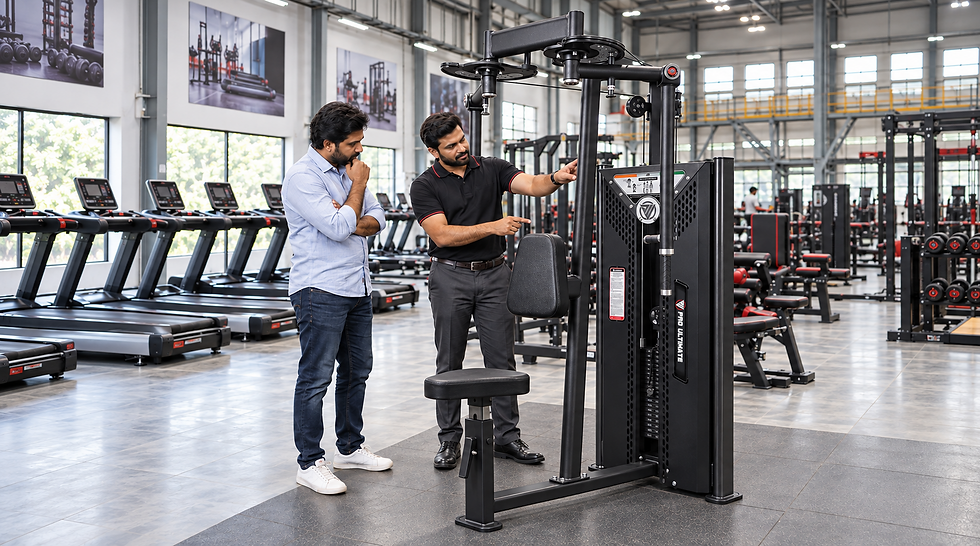
Before investing in gym equipment, don't rely only on pictures, specifications, or a salesperson's words. Visit the showroom and use the equipment yourself, or visit an existing gym branch of the same company. This helps you understand whether the equipment actually meets your business and member requirements.
Before making your final decision, pay attention to these key factors:
Movement & Performance: Use the machine yourself and check whether the movement feels smooth and natural. Equipment should support comfortable movement, especially when it will be used by hundreds of members every day.
Comfort & Adjustability: Check whether the seat, handles, and settings can be adjusted easily. Better comfort can improve the member experience and encourage regular use.
Stability & Noise: Test the machine under proper load and notice any shaking, unwanted movement, or excessive noise. Stable equipment is important for both safety and a better gym environment.
Ease of Use: See how quickly a first-time user can understand and operate the machine. Equipment that is simple to use can reduce confusion and improve overall member experience.
Visit a Showroom or Existing Gym: Don't stop at a showroom demonstration. If possible, visit a gym where the equipment has already been installed and see how it performs in a real commercial environment.
Test Under Real Conditions: Try the equipment at different weights and, where possible, observe it during busy hours. As an investor, you need to know how the equipment will perform under real, everyday gym usage not just during a short demo.
The goal isn't simply to find a machine you like. It's to make sure the equipment you invest in can deliver the performance, comfort, and durability your members expect.
Understand Warranty and After-Sales Support
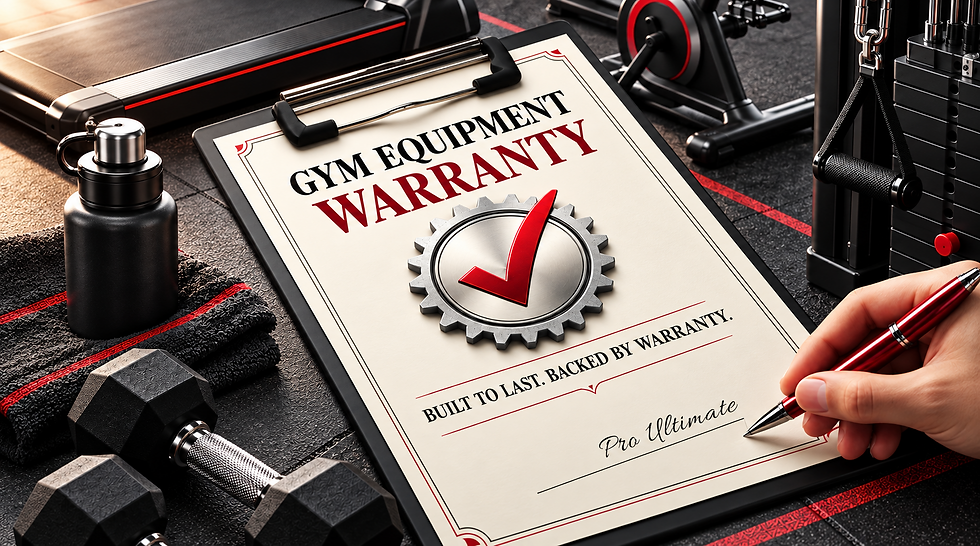
Most buyers read a warranty card once, file it away, and never think about it again until something breaks. But a warranty isn't just paperwork. It's a promise about what happens after the sale, and understanding it properly can save you from real headaches down the line.
What exactly does the warranty cover?
At its core, a warranty is the manufacturer's commitment to fix or replace parts that fail under normal use. Most fitness equipment warranties cover mechanical and electrical repairs for machines like treadmills, ellipticals, and strength equipment when failures happen through regular wear, not misuse. That typically includes drive motors, control boards, consoles, and other core electrical and mechanical parts. But not everything is covered equally which is why it helps to break the warranty down into layers.
Frame vs. mechanical vs. electrical components
A well-structured warranty usually separates coverage into these three buckets, and each one behaves differently:
Frame/structural warranty – This covers the actual skeleton of the machine (welds, steel tubing, load-bearing joints). Structural warranties tend to run longest, sometimes several years, because a well-engineered frame is the part least likely to fail and the most costly if it does.
Mechanical components – Cables, pulleys, guide rods, moving parts. These see more day-to-day stress, so coverage windows here are often shorter than structural coverage.
Electrical components – Motors, consoles, control boards. These fail differently than mechanical parts (often electronics, not wear), so they're usually covered under their own specific terms.
Knowing which bucket a part falls into helps you understand why two components on the same machine can have completely different coverage timelines.
Wear-and-tear exclusions
Here's something a lot of buyers miss: warranties almost never cover consumable or wear items. Belts, pads, grips, and similar parts are typically excluded from coverage entirely, because they're expected to wear out through normal use, not fail due to a defect. This isn't a loophole, it's standard across the industry. The distinction to hold onto is: a warranty protects against defects, not against the natural aging of parts that are designed to be replaced.
Spare-parts availability
This is one of the most overlooked factors and one of the most important. Before buying, it's worth establishing where parts for your specific model are actually stocked: locally, regionally, or only back at the factory. It's also worth asking what the lead time looks like for the components most likely to fail cables, upholstery, adjustment hardware, cardio drive parts and whether the manufacturer commits to keeping parts available for a set number of years even after a model is discontinued, since equipment on a gym floor routinely outlives its place in the catalog.
Technician support and installation
A warranty is only as good as the people who show up to honor it. It's worth knowing upfront whether service is performed by the manufacturer's own technicians, certified third parties, or your own staff using shipped parts. For imported or distributor-sourced equipment, this becomes even more important: clarify which entity actually holds the service obligation, because if the importer-distributor relationship changes, coverage can quietly become orphaned leaving gym owners stuck with a warranty nobody wants to honor.

What happens after warranty expiry?
This is where many gym owners get caught off guard. Equipment can still need repairs after the warranty ends, so it is important to understand what support is available beyond the warranty period. Some suppliers also offer extended protection for longer coverage.
Look at the Manufacturer's Track Record
Before investing, look at what the manufacturer has already delivered. Check their existing commercial installations, real gym projects, and large-scale setups. Visiting an established gym using their equipment can give you a better idea of how the machines perform in real conditions.
Also look at their manufacturing capability, certifications, and quality standards. More importantly, make sure they can show proof of what they claim through completed projects, customer references, or existing installations. Cross checking the past performance is often a better indicator than promises.

“A new machine tells you how it looks. An established installation tells you how it performs.”
Choose a Manufacturer That Understands Your Gym Type
A reliable manufacturer should also understand your gym's needs, budget, space, and future plans. Before you make an investment, consider whether they can support your business beyond simply supplying machines. The following points are discussed to make investors aware of what to be considered before choosing a best gym equipment manufacturer.
Understands your gym type: A manufacturer should understand whether you are setting up a premium gym, budget gym, franchise, hotel gym, or a large fitness facility.
Helps with equipment planning: They should suggest the right mix of cardio, strength, functional, and other equipment based on your space and target members.
Understands your budget: A reliable manufacturer should help you make the best use of your equipment budget rather than simply pushing the most expensive machines.
Supports gym expansion: If you plan to open more branches, the manufacturer should have the production capacity and systems to maintain consistency across locations.
Provides practical support: Installation, training, servicing, spare parts, and technical support should be part of the relationship not something you have to figure out alone.

Comments