


Home Gym Setup Guide 2026: Gym essentials you should have?
Updated: 7 days ago

Not long ago, a home gym meant a pair of dumbbells and a yoga mat in the corner of a bedroom. In 2026, it's something far more valuable: a long-term investment in your health, privacy and convenience, a private, always-open training space that saves you hours every week and pays you back for decades.
But building one isn't as simple as adding items to a cart. Too many options lead to mismatched equipment, wasted space and money spent on machines that never get used.
This guide fixes that. By the end, you'll know how much space you need, what to budget, which equipment to buy first, and which mistakes to avoid.
Why Build a Home Gym in 2026?
The case for home gym equipment India buyers are increasingly choosing over traditional memberships has never been stronger, and it comes down to three things.
Convenience and privacy - No commute, no crowded peak hours, no waiting for a machine. You train when your schedule allows, whether that's 5 a.m. or midnight, in a space that's entirely yours.
Long-term value - A premium gym membership can cost a significant amount every year, and the fees keep coming. Quality equipment is a one-time investment that can last well over a decade. Over five years or more, a home gym often costs less than a single membership, and the savings multiply if several family members train.
Whole-family use - A well-planned gym serves everyone at home. One person lifts, another runs, and a parent focuses on mobility and recovery, all under one roof.
How Much Space Do You Need for a Home Gym?
Space decides everything else, so measure before you buy. Here are three realistic setups.
Compact Setup (100-150 sq ft)
Ideal for a spare bedroom or a corner of a larger room. It fits a bench, an adjustable dumbbell set, a compact rack or functional trainer, and one foldable cardio machine. Choose multi-function equipment that earns its footprint.
Standard Setup (200-400 sq ft)
The sweet spot for most homeowners. It comfortably holds a power rack with a barbell and plates, a bench, a cable machine, and a treadmill or bike, with clear walking space around each.
Premium Setup (500+ sq ft)
A dedicated gym room or private suite. Here you can add zones for strength, cardio and stretching, plus selectorised machines like a leg press and chest press.
Quick Space Checklist
Ceiling height: at least 8-9 feet if you plan to use a power rack or do overhead presses.
Flooring: rubber mats or gym-grade flooring to protect joints, equipment and the floor beneath.
Ventilation and cooling: good airflow or air conditioning makes training far more comfortable.

Home Gym Budget Guide: What Should You Spend?
The budget is where most home gym plans go wrong. Some buyers overspend on machines they rarely use, while others skimp on the basics and replace equipment within a couple of years. The goal is to spend in the right places, so every rupee goes toward equipment that lasts and gets used.
There's no fixed package here, because no two home gyms are the same. At Pro Ultimate, we plan your equipment around your budget, your space and your goals.
How We Plan Your Home Gym Around Your Budget
1. You share your budget - Whether it's modest or unlimited, that number becomes the starting point.
2. We look at your space and goals - Room size, ceiling height, the number of people training and what you want to achieve (strength, fat loss, conditioning or family fitness) shape the equipment list.
3. We build a custom equipment plan - You get a recommended list of machines and accessories, prioritised so your budget goes to the essentials first. Anything else can be added in phases.
4. We deliver, install and support - Your gym is installed properly and backed by service and spare parts.
Where to Spend More and Where to Save
Spend more on anything you'll use daily or that bears heavy load: the rack, bench, barbell, treadmill and cable machine. Build quality and safety matter most here.
Save on accessories like resistance bands, foam rollers and storage, which are inexpensive and easy to upgrade later.
Home Gym Essentials in Order of Priority
Most people build a home gym the wrong way round. They buy the exciting machine first, then discover there's no proper flooring, no room to move, or no way to train safely alone. The result is a gym that looks impressive but doesn't work.
The fix is to buy in the right order. Every item below supports the next: the floor protects your equipment, the free weights build your base, the rack adds heavy strength training, and the machines round out the setup. Follow this sequence and each purchase makes the next one more useful. It also lets you spread your investment over time without ever having an incomplete gym.
Here is the order we recommend, and the reasoning behind each step.
1. Flooring and Foundation
Start here, before any equipment arrives. Good flooring absorbs the impact of dropped weights, cuts noise and vibration, cushions your joints, and keeps heavy machines stable and level. It's the most overlooked purchase in a home gym, and fixing a damaged floor costs far more than installing the right tiles first.
Which flooring to choose:
Ground floor: 15 mm rubber tiles. Approx. ₹110 per sq ft + 18% GST.
Above ground floor: 20 mm rubber tiles for extra shock and noise absorption. Approx. ₹110 per sq ft + 18% GST.
Connecting tiles: interlocking tiles that are quick to lay and easy to move or replace. Starting from approx. ₹150 per sq ft + 18% GST.
For example, a 150 sq ft compact gym in rubber tiles costs about ₹16,500 + GST.
2. Dumbbells, Weight Plates and Adjustable Bench
Adjustable dumbbells and a sturdy, multi-angle bench are the backbone of a home gym. One set of adjustable dumbbells replaces an entire rack of fixed weights, saving space and money. With a bench that adjusts from flat to incline to decline, you can train your chest, shoulders, back, arms and legs, all from one small corner. An adjustable bench starts at around ₹40,000-50,000 + GST, and plates are about ₹125 per kg + GST.
3. Power Rack and Barbell
When you're ready for serious strength training, a power rack with a barbell and weight plates is the centrepiece of the gym. It lets you squat, bench press, overhead press and pull with heavy loads, and it is the best tool for building strength and muscle over the long term.
The key feature is safety. Adjustable safety bars catch the weight if you fail a lift, so you can train hard even when you're alone, with no spotter needed. Check the rack's steel thickness, its weight capacity and its footprint against your ceiling height before you buy. If space and budget allow, a power rack turns your plates and barbell into a complete heavy-lifting station.
4. Cardio Machine
Cardio keeps your heart healthy and supports fat loss, recovery and stamina. Finding the best cardio machine for home use really comes down to your goals and available space.
Whichever you choose, pick one you will genuinely enjoy using. The best cardio machine is the one you use consistently.
5. Functional Trainer or Multi-Station
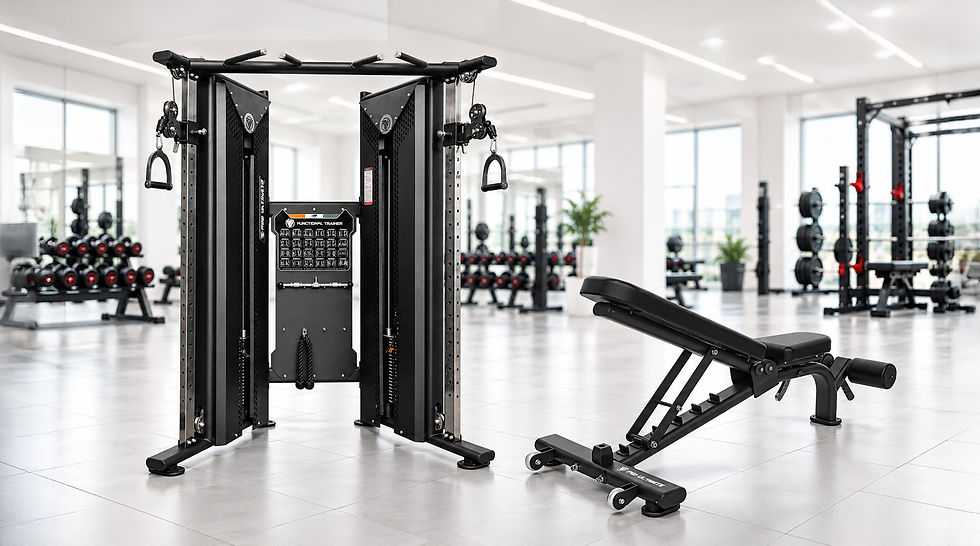
Once the basics are in place, a cable-based functional trainer adds the most variety for the least space. Its adjustable pulleys and weight stacks let you perform hundreds of exercises, from cable flies and rows to triceps pushdowns, core work and mobility movements, all in one machine.
It is also the best choice for a family or shared gym, since beginners and advanced users can train on it safely with quick, easy weight changes. A multi-station works in a similar way, combining several exercises in one compact frame. If you're comparing options, the functional trainer machine price typically starts around ₹2.3 lakh + GST, depending on pulley configuration and weight stack capacity.
Best Home Gym Machines: Core Equipment
Treadmill
The most requested cardio machine. It suits every fitness level, from walking to interval running, and supports fat loss and heart health. Look for a strong motor, a wide deck, good cushioning and a solid warranty.
Best for: runners, walkers and weight management.
Approx. price: ₹1.2 lakh + 18% GST
Spin Bike
Low-impact, quiet and compact. It's easy on the joints and works for steady rides or high-intensity intervals, which makes it a smart pick for smaller rooms.
Best for: beginners, older users and anyone who wants cardio without impact.
Approx. price: ₹25,000 + 18% GST
Functional Trainer
The most versatile machine in the gym. Adjustable pulleys and weight stacks train every muscle group in a footprint of about 6 x 8 ft, and it's easy to adjust between users.
Best for: full-body strength training, families and shared gyms.
Approx. price: ₹2.2 lakh + 18% GST
Adjustable Bench
Used in almost every workout. It adjusts from flat to incline to decline for presses, rows, curls and more. Look for a strong frame, dense padding and a high weight rating.
Best for: anyone training with dumbbells or a barbell.
Approx. price: ₹40,000-50,000 + 18% GST
Dumbbells and Weight Plates
The foundation of strength training. Dumbbells handle isolation work, while weight plates and a barbell allow heavy lifts like squats, deadlifts and presses, with room to progress as you get stronger.
Best for: every level, from beginner to advanced.
Approx. price: ₹125 per kg (for example, 100 kg of plates is about ₹12,500)
Not sure what fits your room or budget? Our team will plan the right combination for you. Explore our range of commercial-grade machines built for home use.
Note: Prices shown are approximate and may vary by model, specification and configuration. Contact our team for an exact quote.
Conclusion
Plan it well and your home gym becomes one of the most valuable investments you make in your health, your time and your lifestyle.
Before you buy, read our guide to the common home gym mistakes to avoid so you don't repeat the errors that cost buyers the most.
Ready to build yours? Share your budget and space, and our team will plan a home gym around them. Book your free consultation. Contact (7087412971)
If you meant something else, tell me and I'll adjust the first paragraph to match.
Frequently Asked Questions
Is a home gym better than joining a fitness center?
A home gym offers convenience, privacy and long-term savings. You train whenever you want, with no commute, no crowds and no waiting for machines. Over several years, the cost is often lower than a premium membership for one person, and much lower for a family. A gym center still suits people who want classes, trainers or a social setting.
What should I consider before buying home gym equipment?
Consider your fitness goals, available space, budget, equipment quality and after-sales support. Measure your room, ceiling height and doorways first. Commercial-grade, durable equipment costs more upfront but gives the best long-term value, safety and resale life. Ask about warranty, installation and spare parts before you buy.
What equipment do I need for a complete home gym?
A complete home gym needs a treadmill or spin bike, a functional trainer, an adjustable bench, and dumbbells or weight plates, on proper rubber flooring. A core setup costs roughly ₹5 lakh including GST. You can start with the essentials and add machines as your space and budget allow.
What accessories can be added to a home gym?
Popular home gym accessories include dumbbells, vinyl dumbbells, kettlebells, a multi-purpose rack, weight racks and grips. They add variety, keep your gym organised and improve safety. Start with one or two that suit your goals and space, then add more over time.
Comments